Content insight
Toggle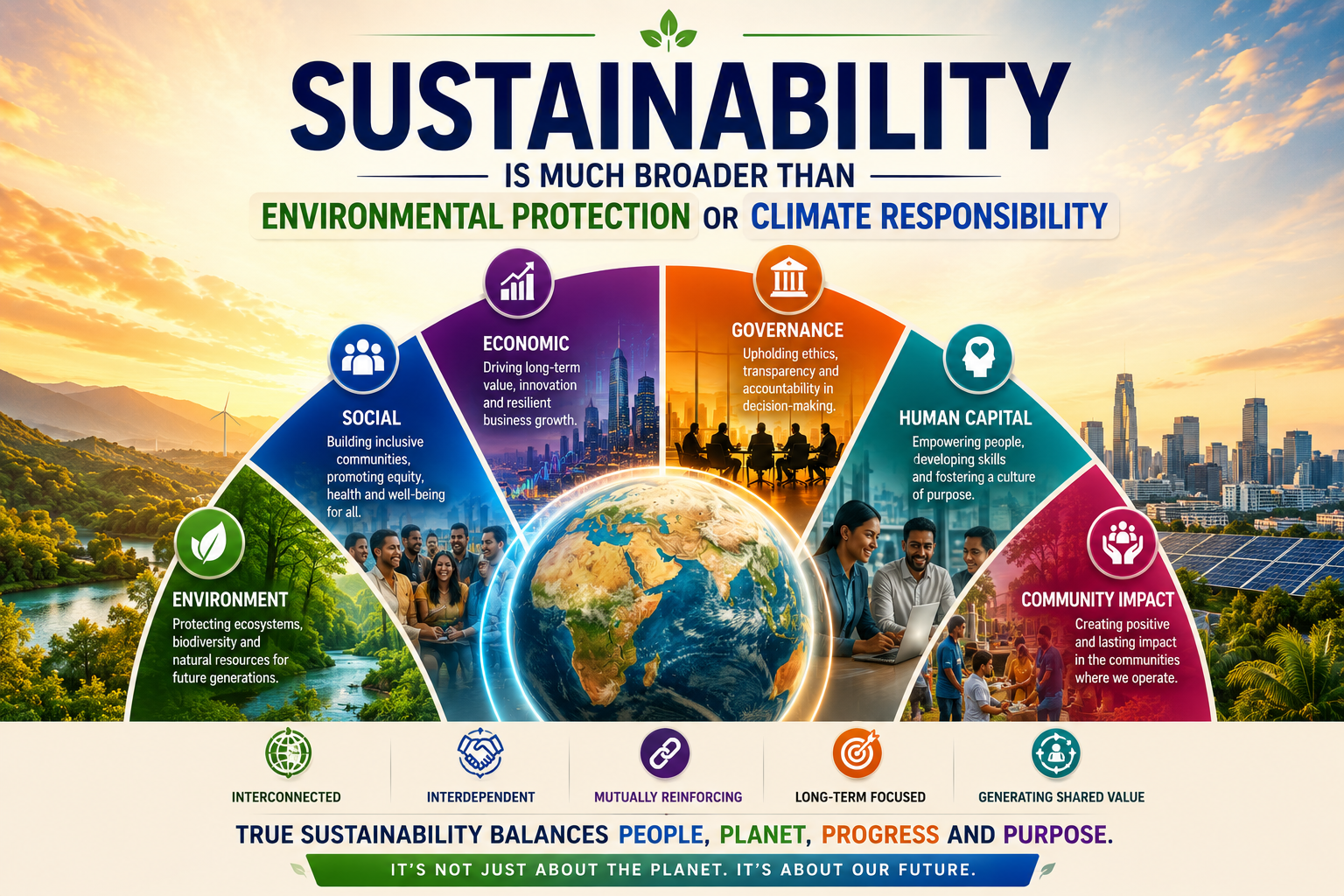
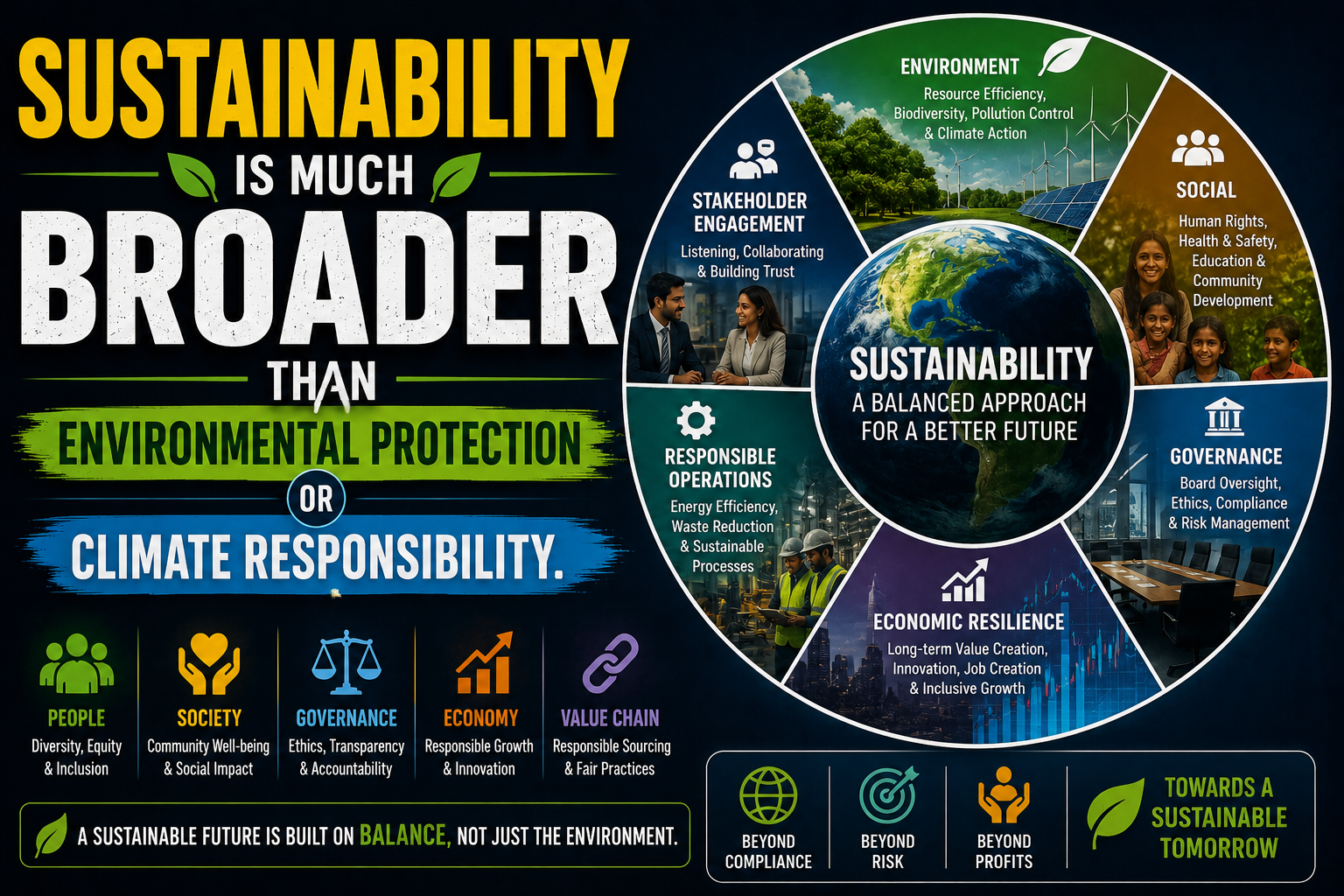
Sustainability is often misunderstood as only environmental protection or climate responsibility.
In reality, sustainability is much broader.
Sustainability is the ability to meet present needs without reducing the ability of future generations to meet theirs. It is the discipline of creating value today while preserving the economic, social, environmental, and institutional foundations needed for tomorrow.
For boards, promoters, and leadership teams, sustainability is not merely a reporting requirement.
It is a strategic approach to long-term resilience.
At its core, sustainability asks one simple but powerful question:
Are today’s decisions creating tomorrow’s strength—or tomorrow’s problems?
True sustainability exists when organizations balance three interconnected pillars often called the Triple Bottom Line:
Planet. People. Profit.
These pillars cannot operate independently.
Long-term success happens only when all three remain healthy.
1. Environmental Sustainability — Protecting the Foundation of Growth
Environmental sustainability focuses on ensuring that economic activity does not consume natural resources faster than they can regenerate.
Traditionally, environmental action was considered a responsibility of governments and environmental agencies.
Today, it has become a boardroom issue.
Organizations are increasingly expected to manage:
• Carbon emissions
• Energy efficiency
• Water conservation
• Waste reduction
• Circular resource use
• Sustainable sourcing
• Climate resilience
Environmental sustainability is not simply about reducing environmental harm.
It is about protecting business continuity.
For example:
- A manufacturing company facing water shortages may experience production delays.
- An energy-intensive company may face rising operating costs.
- A supply chain exposed to climate disruption may become unstable.
Strong boards now evaluate environmental risks as business risks.
Forward-looking organizations understand, Natural resources are not unlimited.
Growth that damages future operating capability is not sustainable growth.
2. Social Sustainability — Building Trust, Capability, and Human Strength
No company succeeds without people.
Social sustainability focuses on creating systems that improve human well-being while maintaining fairness, inclusion, and opportunity.
This includes:
• Human rights
• Fair labor practices
• Employee well-being
• Health and safety
• Gender inclusion
• Education and skill development
• Ethical supply chains
• Community engagement
Many governance failures begin as social failures.
Organizations often lose performance long before they lose profits.
Examples:
Employees stop speaking openly.
Leadership becomes isolated.
Trust declines.
High performers leave.
Innovation slows.
Culture weakens.
Social sustainability means creating organizations where people can contribute, grow, and remain engaged.
Boards should regularly ask:
Are people staying because they want to—or because they have no alternative?
Because healthy culture creates sustainable performance.
3. Economic Sustainability — Creating Prosperity That Lasts
Economic sustainability does not reject profit. It strengthens it.
Its objective is to create financial growth that remains resilient over time rather than generating short-term gains that create future instability.
Economic sustainability requires organizations to balance:
• Profitability
• Governance
• Investment discipline
• Innovation
• Risk management
• Resource efficiency
• Long-term competitiveness
Examples of unsustainable growth:
- Rapid expansion without controls.
- Excessive founder dependency.
- Short-term profit at the expense of culture.
- Ignoring succession planning.
- Underinvestment in technology.
- Strong economic sustainability means:
- Growth today should not weaken tomorrow.
Boards increasingly evaluate not only financial outcomes but also whether business models remain viable in changing conditions.
Sustainable Development Goals (SDGs): A Global Framework for Long-Term Progress
To create a common direction for governments, businesses, and society, the United Nations established the Sustainable Development Goals.
These goals provide a practical roadmap for sustainability.
Protecting the Planet
Climate action, life below water, life on land.
Improving Human Well-being
No poverty, zero hunger, good health and well-being.
Strengthening Society
Quality education, gender equality, reduced inequalities.
Supporting Economic Development
Affordable clean energy, sustainable cities, responsible consumption, innovation and infrastructure.
Organizations increasingly align strategy and governance practices with these goals because sustainability is becoming an important driver of competitiveness and reputation.
Sustainability in Everyday Practice
For Individuals
Sustainability begins with daily choices.
Examples include:
• Reducing waste
• Saving water and energy
• Supporting responsible consumption
• Choosing durable products
• Reducing unnecessary consumption
Small actions become meaningful when practiced consistently.
For Businesses
Organizations create larger impact through structural decisions.
Examples include:
• Renewable energy adoption
• Circular economy models
• Ethical sourcing
• Digital efficiency initiatives
• Employee development programs
• Sustainable product design
• Responsible technology adoption
Sustainability should not operate as a separate initiative.
It should influence strategy, operations, governance, and investment decisions.
Sustainability and Board Governance
The strongest boards no longer ask:
“How do we maximize quarterly performance?”
They ask:
“How do we build an organization that remains trusted, competitive, and valuable for decades?”
This is where sustainability becomes leadership.
It requires balancing:
Short-term performance with long-term resilience.
- Technology with ethics.
- Growth with accountability.
- Profit with responsibility.
How an Independent Director Can Contribute to ESG for the Board, Company, and Stakeholders
Environmental, Social, and Governance (ESG) is no longer a separate corporate initiative.
It is becoming an important part of how organizations build resilience, maintain trust, attract investment, manage risks, and create sustainable growth.
An independent director plays a unique role because they bring objectivity, independent judgment, and long-term perspective.
Their responsibility is not to run ESG programs.
Their responsibility is to ensure ESG becomes part of strategic decision-making.
1. Contribution to the Board: Strengthening Strategic Oversight
Boards are expected to look beyond quarterly performance.
An independent director helps ensure that ESG is discussed as a strategic issue rather than a reporting exercise.
Key contributions include:
• Integrating ESG into board agendas
• Challenging short-term decision-making
• Monitoring emerging ESG risks
• Improving governance discipline
• Ensuring accountability across committees
• Bringing an independent external perspective
Questions an independent director may ask:
- Are ESG risks included in strategy discussions?
- Are we measuring what truly matters?
- What future risks are we creating today?
- Is growth being achieved responsibly?
This improves board quality and long-term thinking.
2. Contribution to the Company: Building Sustainable Performance
Independent directors help management balance growth with resilience.
Environmental Contribution
Supporting oversight on:
• climate-related risks
• energy efficiency
• resource management
• sustainable operations
• long-term environmental exposure
Social Contribution
Supporting initiatives around:
• employee well-being
• diversity and inclusion
• leadership development
• culture and accountability
• human capital strategy
Governance Contribution
Strengthening:
• ethical leadership
• transparent reporting
• compliance oversight
• succession planning
• decision quality
• risk management
The objective is not simply good ESG scores.
The objective is building a stronger company.
3. Contribution to Stakeholders: Protecting Long-Term Trust
Stakeholders today expect more than financial performance.
Independent directors help protect:
Shareholders
Through:
• long-term value creation
• stronger risk oversight
• sustainable profitability
Employees
Through:
• healthy culture
• fair opportunity
• leadership accountability
Customers
Through:
• trust
• product responsibility
• ethical business practices
Communities
Through:
• responsible operations
• social contribution
• long-term impact
Regulators and Investors
Through:
• transparency
• governance maturity
• responsible disclosures
Strong stakeholder trust becomes a strategic advantage.
4. Bringing Technology and AI Perspective into ESG
Modern ESG increasingly depends on data.
An independent director with AI and technology awareness can help:
• improve ESG reporting quality
• monitor sustainability metrics
• identify emerging risks earlier
• track supply chain exposure
• improve board dashboards
• strengthen scenario planning
Technology improves visibility.
Governance improves decisions.
5. Acting as the Voice of Long-Term Stewardship
Perhaps the most important contribution of an independent director is stewardship.
Independent directors help boards ask:
Will today’s decisions strengthen or weaken the organization five years from now?
Will growth today create future risk?
Are we building an institution—or only quarterly results?
This perspective creates sustainable value.
Closing Reflection
Sustainability is not about sacrificing growth.
It is about ensuring growth remains possible.
Organizations that understand this do not merely create financial results.
They create institutions capable of serving customers, employees, shareholders, and society across generations.
other Related Topics
The Cost of Ignoring Governance
Crisis Preparedness: The Real Test of Board Governance
Risk Management Is a Strategic Function, Not a Formality
Decision Fatigue: The Hidden Threat to Business Performance
AI Is No Longer a Technology Issue—It Is a Board Issue