Content insight
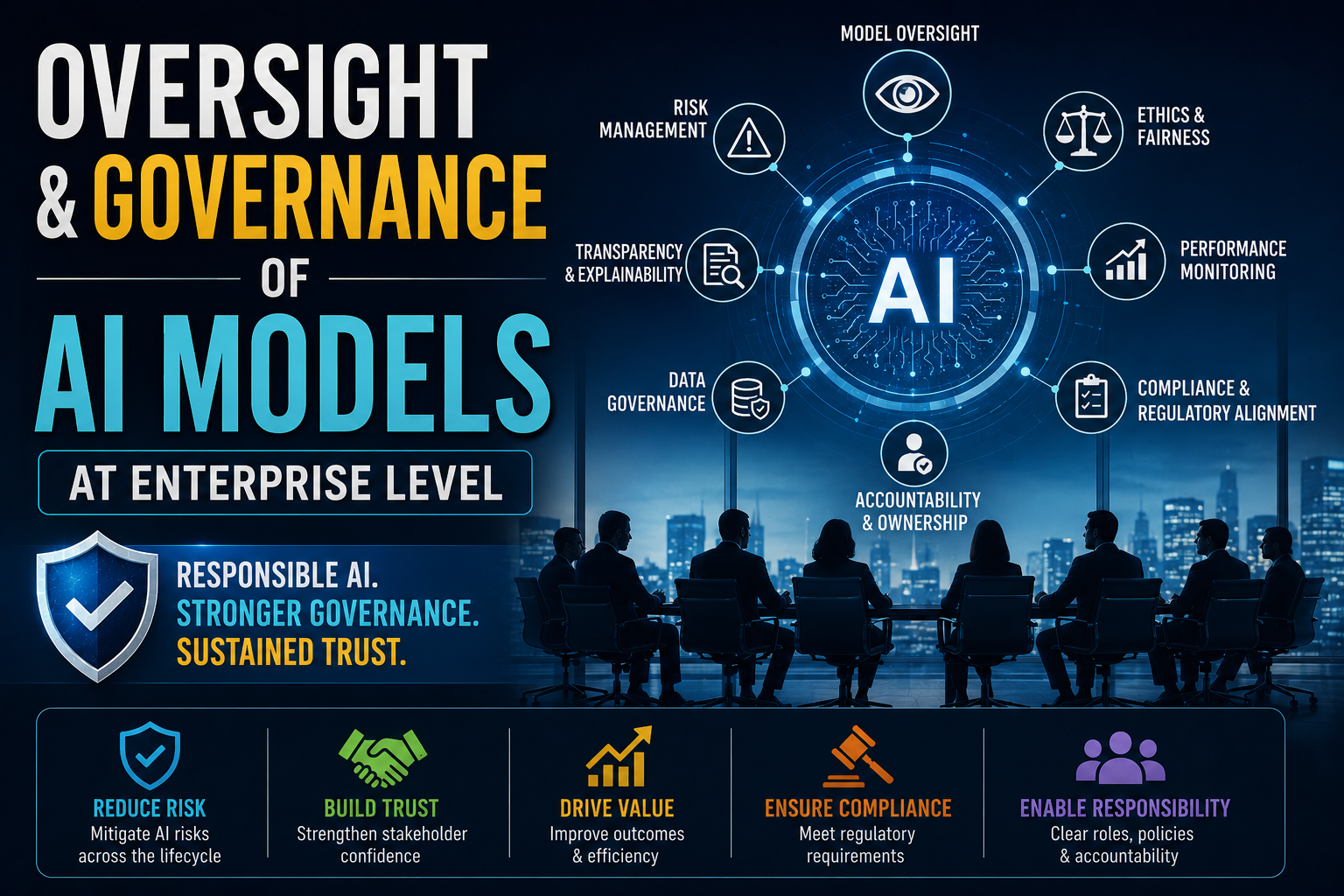
Toggleoversight and governance of AI models at an enterprise level, one of the most valuable skills an Independent Director, Audit Committee Member, Risk Committee Member, or Financial Services Board Member can develop over the next decade.
For banks, NBFCs, insurance companies, fin techs, mutual funds, and listed companies, the board is not expected to build AI models. Instead, the board is expected to govern AI responsibly—ensuring it creates value while managing risks.
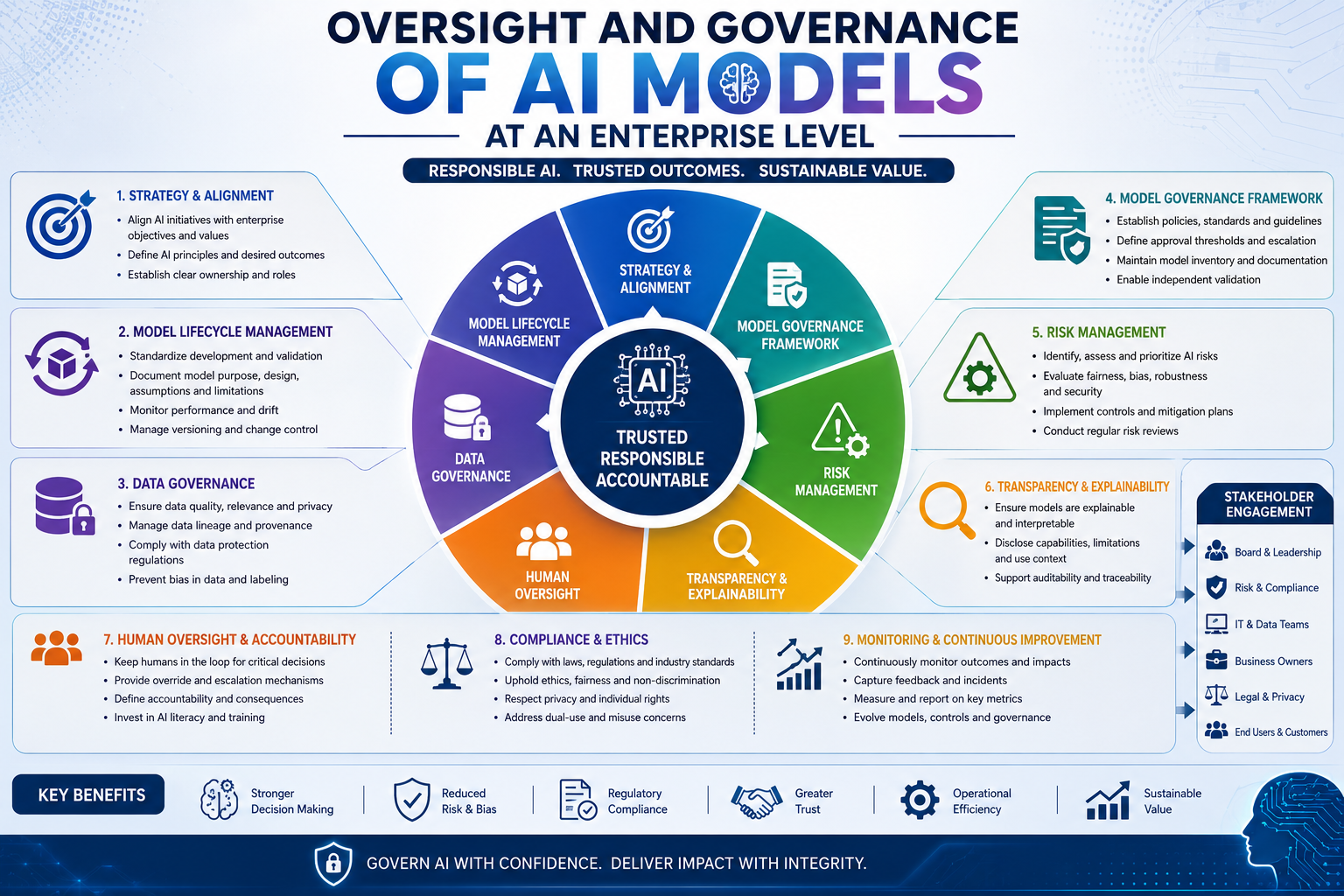
Governance AI at the Enterprise Level
AI governance is the framework through which a board ensures that AI systems are developed, deployed, monitored, and retired in a way that is ethical, secure, compliant, transparent, and aligned with the company’s strategy.
Management builds AI. The Board governs AI.
The board’s role is similar to its role in financial reporting:
- The CFO prepares financial statements.
- Auditors review them.
- The Board oversees the integrity of the process.
Similarly:
- Data scientists develop AI models.
- Management implements them.
- The Board ensures appropriate oversight.
Why Boards Must Govern AI
AI now influences critical decisions, such as:
- Loan approvals
- Insurance underwriting
- Credit scoring
- Fraud detection
- Customer service
- Investment recommendations
- AML (Anti-Money Laundering) monitoring
- Cybersecurity
- Hiring
- Pricing
If AI produces biased, inaccurate, or opaque decisions, the consequences can include:
- Regulatory penalties
- Customer lawsuits
- Reputational damage
- Financial losses
- Data privacy breaches
- Loss of stakeholder trust
Therefore, AI governance is now a board responsibility.
The Board's Role in Governance of AI
An effective board should oversee AI in several key areas.
1. Governance of AI Strategy
The board should ask:
- Why are we using AI?
- Which business problems are we solving?
- Does AI align with our business strategy?
- What is the expected return on investment?
- Are we solving real customer problems or simply following a trend?
Example:
A bank introduces AI to reduce loan approval time from five days to five minutes while maintaining risk quality.
The board evaluates whether this supports the organization’s long-term strategy.
2. AI Risk Oversight
Every AI system introduces risks.
Boards should review:
Operational Risks
- Incorrect predictions
- Model failure
- Poor-quality data
- System outages
Regulatory Risks
- RBI compliance (for banks and NBFCs)
- Data protection requirements
- Consumer protection obligations
Reputational Risks
If AI wrongly rejects deserving customers or produces discriminatory outcomes, public trust can be damaged.
Financial Risks
Poor AI decisions can lead to increased defaults, fraud losses, or operational costs.
3. Model Risk Management
Every AI model should be treated as a business asset that requires oversight.
The board should understand:
- How was the model developed?
- What data was used?
- How accurate is it?
- How often is it validated?
- Who approved it?
- How is performance monitored?
This is known as the AI model lifecycle.
AI Model Lifecycle
Every model typically goes through these stages:
- Business problem identification
- Data collection
- Data cleaning
- Model development
- Model testing
- Independent validation
- Board or committee approval (as applicable)
- Deployment
- Continuous monitoring
- Periodic review
- Retirement or replacement
Boards should ensure there are controls at each stage.
Model Validation
Independent validation is essential.
Validation checks:
- Accuracy
- Stability
- Bias
- Explainability
- Reliability
- Robustness
This is similar to an internal audit of the model.
Explainable AI
A key question for boards is:
Can we explain how the AI reached its decision?
For example:
If a customer is denied a loan, the organization should be able to explain why.
Black-box AI without accountability is generally unsuitable for high-impact decisions.
Bias and Fairness
AI learns from historical data.
If the historical data contains bias, AI can perpetuate or amplify it.
Example:
If past lending decisions unfairly favored one group, AI trained on that data may continue the pattern.
Boards should ensure fairness testing is part of AI governance.
Data Governance
AI is only as good as the data it uses.
Boards should oversee:
- Data quality
- Data ownership
- Privacy
- Security
- Accuracy
- Access controls
- Compliance with applicable data protection laws
AI Ethics
Boards should establish ethical principles such as:
- Fairness
- Transparency
- Accountability
- Human oversight
- Privacy
- Non-discrimination
- Responsible innovation
Ethics is a governance issue, not just a technical one.
Human Oversight
High-impact AI decisions should not be fully automated.
Examples include:
- Large loan approvals
- Employee termination
- Investment decisions
- Fraud investigations
Boards should ensure there is meaningful human review where appropriate.
Cybersecurity
AI systems themselves can become targets.
Boards should consider:
- Data poisoning
- Prompt injection (for generative AI)
- Unauthorized model access
- Model theft
- Adversarial attacks
AI governance should be integrated with cybersecurity oversight.
Regulatory Compliance
Boards should monitor developments from relevant regulators and standards bodies. Depending on the organization, these may include:
- Financial sector regulators
- Data protection authorities
- Securities regulators
- International AI governance frameworks (where relevant)
Policies should be reviewed as regulations evolve.
AI Governance Committee
Many organizations establish a cross-functional AI governance group.
Typical participants include:
- Chief Risk Officer
- Chief Information Officer
- Chief Technology Officer
- Chief Data Officer
- Compliance Head
- Information Security Head
- Legal Counsel
- Internal Audit
- Business Leaders
The board or a board committee receives regular updates from this group.
Questions Every Board Should Ask About AI
- What AI systems are currently in use?
- Who is accountable for each AI model?
- How are models independently validated?
- How do we monitor model performance over time?
- How do we identify and mitigate bias?
- How is customer data protected?
- What happens if an AI model fails?
- Which regulations apply to our AI use?
- How do we ensure human oversight?
- How does AI create measurable business value?