Content insight
Toggle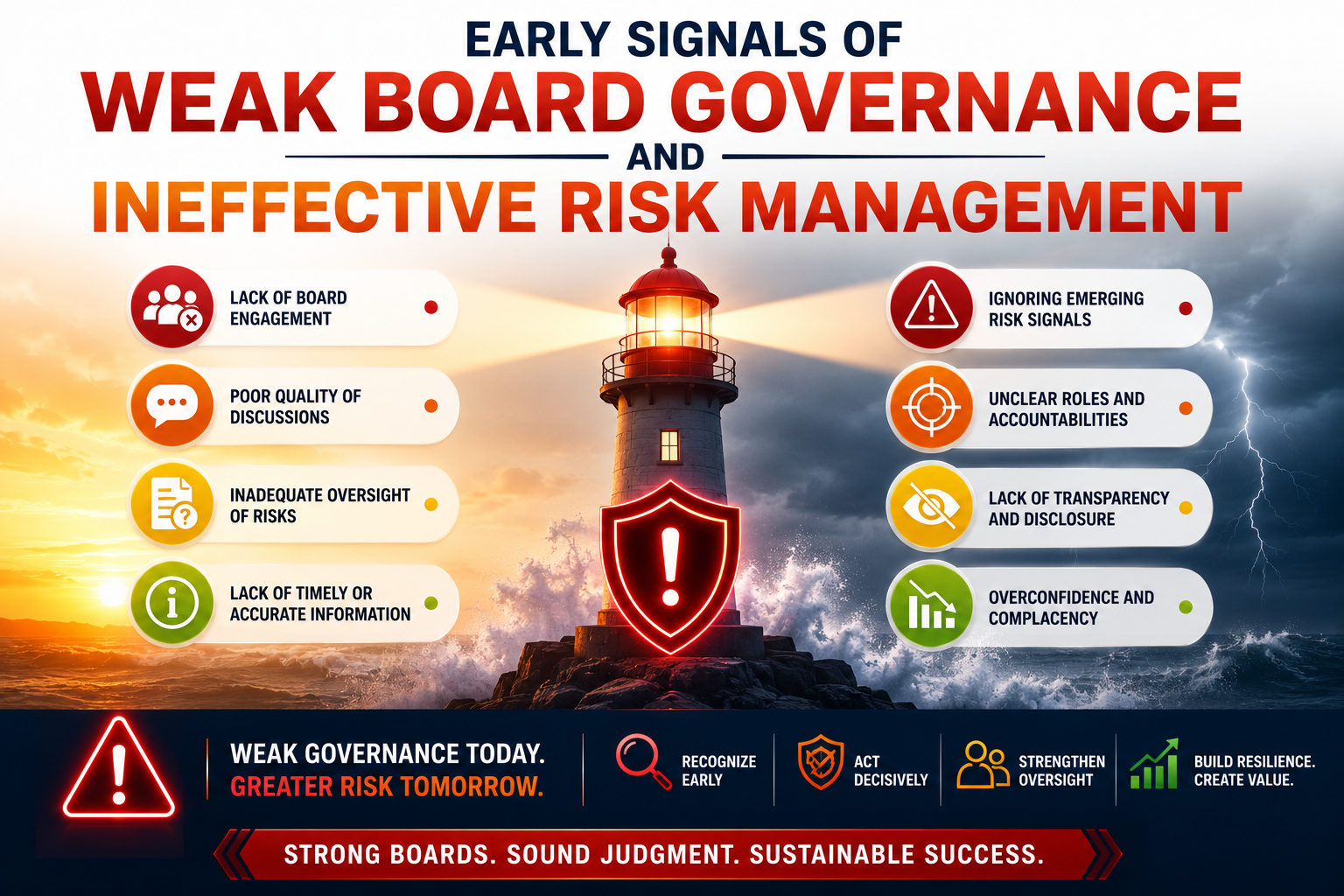
Early signals of weak board governance and ineffective risk management.
Most companies do not fail overnight. In many cases, the warning signs are visible long before a crisis appears.
Employee exits increase. Reporting slows down. Accountability weakens. Leadership decisions go unchallenged. Meetings become silent when difficult questions should be asked.
These are not isolated events. They are early signals of weak board governance and ineffective risk management.
The challenge is that organizations often see these issues separately. Very few connect them as Board risks until the consequences become visible.
This is where strong board leadership creates real value.
Through experience in finance, compliance, audit, and operational oversight, one lesson becomes clear: risk rarely arrives loudly. Governance failures usually begin quietly, through patterns that are ignored because they seem manageable at first.
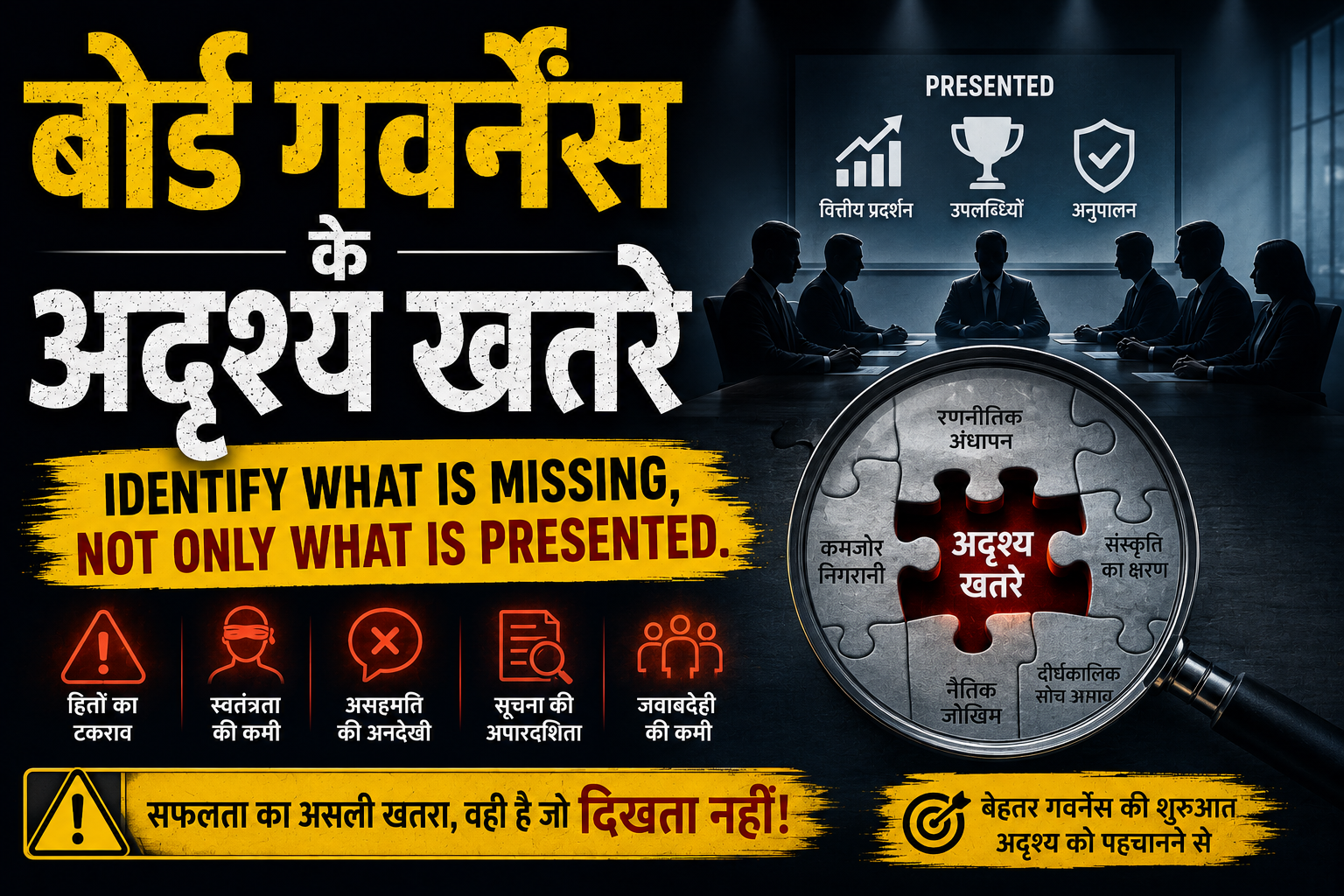
A strong board Governance does not simply review reports or presentations. Effective corporate governance requires directors who can identify what is missing, not only what is presented.
The important questions are often:
- What are we not seeing?
• What is not being reported?
• Which risk is slowly becoming accepted as normal?
• Are short-term gains creating long-term governance issues?
These questions define the quality of board oversight.
The teachings of the offer a timeless principle that remains highly relevant for board leadership today: awareness without action has little value.
A board may identify a concern, but unless it acts with clarity and responsibility, the risk continues to grow.
That is why modern corporate governance requires more than compliance. It requires independent directors and board members who bring:
- Independent thinking
• Ethical judgment
• Courage to challenge assumptions
• Strategic foresight
• Long-term value orientation
The role of an independent director in board Governance is not to make meetings comfortable.
The role is to strengthen governance by asking difficult questions before problems become expensive.
Strong board governance is built when leaders:
- Identify risk before it becomes visible in financial results
• Listen beyond formal reporting
• Understand behavior as well as numbers
• Balance growth with governance discipline
• Protect organizational culture alongside profitability
Financial reports show performance.
Culture reveals sustainability.
And sustainable organizations are built by boards that understand risk management as a strategic function, not merely a formal process.
In today’s environment, companies need boards that do not react only when a crisis appears. They need boards that think deeply, act early, and protect long-term trust.
vukbukkbkb
jfjfjfj
Pingback: The Critical Role of Crisis Preparedness in Strong Board Governance
Pingback: countability is the Real Governance Problem
Pingback: Board Readiness in the 21st Century
Pingback: The Cost of Ignoring Governance - Ethical Governance Independent Director