Content insight
Toggle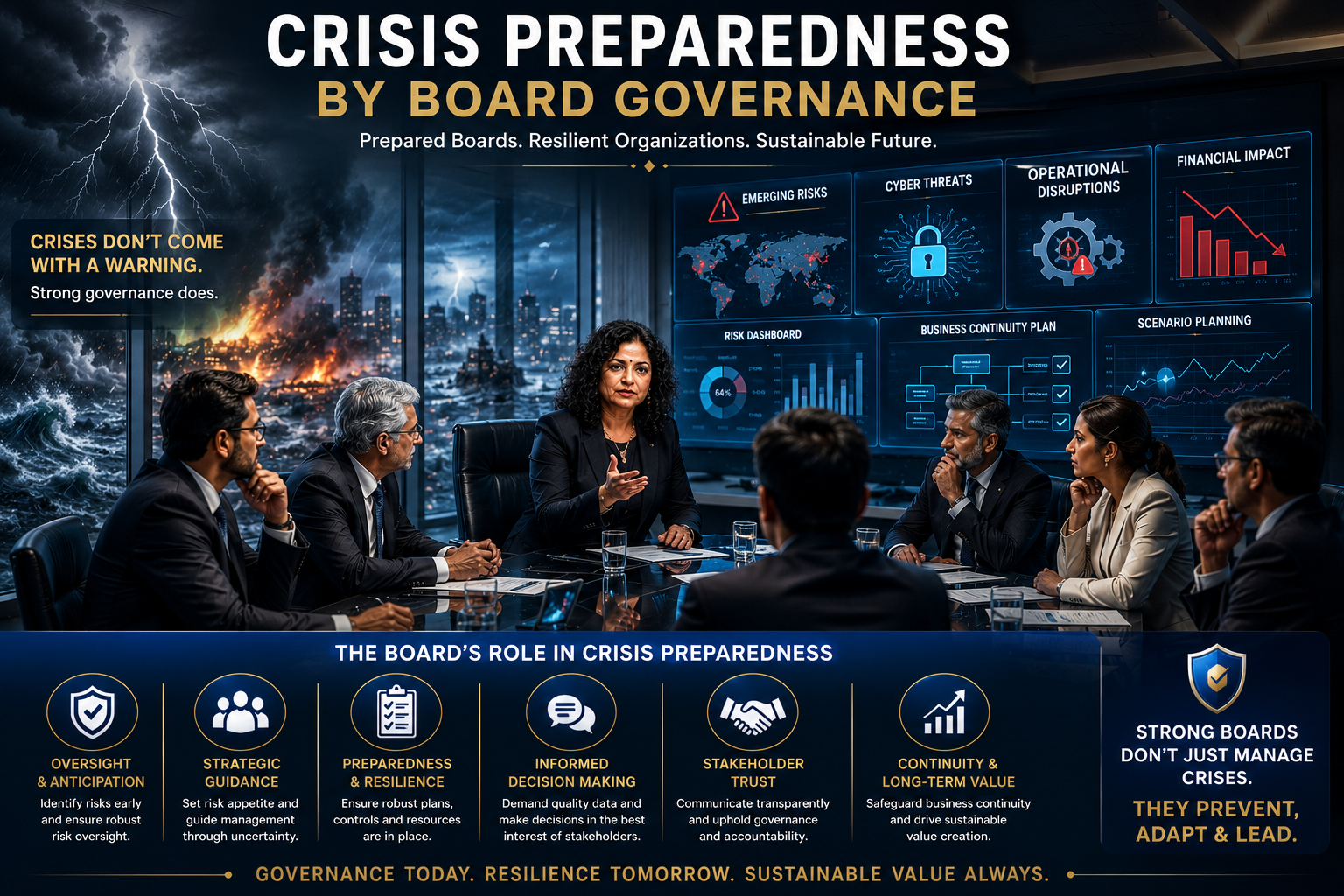
Current Problem
Most organizations invest significant time discussing growth, profitability, market expansion, and operational efficiency. However, very few devote the same level of attention to crisis preparedness.
“Most crises are preceded by governance warning signs that often go unnoticed. As discussed in our article, ‘The Cost of Ignoring Governance,’ small governance failures can eventually develop into major organizational risks.”
The reality is that crises rarely arrive with advance notice.
A cyberattack can halt operations overnight. A regulatory investigation can damage reputation. A key executive’s sudden departure can create leadership uncertainty. A product failure, supply chain disruption, fraud incident, or social media controversy can quickly escalate into a business crisis.
What makes these situations dangerous is not always the crisis itself.
It is the lack of preparedness.
Many companies assume that because they have insurance, policies, or compliance frameworks in place, they are protected. Unfortunately, history has repeatedly shown that organizations often discover weaknesses in their crisis management capabilities only when facing a real emergency.
Insight
A crisis is not merely an operational event.
It is a governance event.
“Organizations with functional boards tend to identify emerging risks earlier than organizations where governance remains a compliance exercise.”
When a crisis occurs, stakeholders do not only evaluate management’s response. They also evaluate the effectiveness of board oversight, risk management, leadership succession, communication, and organizational resilience.
The strongest companies are not those that avoid every crisis.
They are the companies that respond effectively because they prepared before the crisis occurred.
Consider some of the major corporate crises of recent years. Whether involving cybersecurity breaches, governance failures, regulatory actions, or operational disruptions, a common pattern emerges.
Warning signs existed.
Risks were known.
Controls were discussed.
Yet preparedness was insufficient.
Strong board governance recognizes that risk management is not about predicting every crisis. It is about ensuring the organization can withstand and recover from unexpected events.
As the Bhagavad Gita teaches, clarity and preparedness are developed before the moment of action arrives. When uncertainty appears, calm judgment becomes a competitive advantage.
The same principle applies to governance.
Organizations that prepare during stable times perform better during turbulent times.
Board-Level Recommendation
Boards should treat crisis preparedness as a strategic governance responsibility rather than a compliance exercise.
Key areas of focus include:
Enterprise Risk Identification
Boards should regularly review strategic, operational, cyber, financial, regulatory, and reputational risks.
Crisis Response Planning
Every organization should have a documented and tested crisis management framework that clearly defines roles, responsibilities, escalation procedures, and communication protocols.
Cyber Resilience
As cyber threats continue to increase, boards must ensure that cybersecurity preparedness receives regular oversight and review.
Leadership Succession Planning
Organizations should be prepared for unexpected leadership transitions. Over-dependence on a single founder or executive creates significant governance risk.
Business Continuity and Recovery
Critical operations should be capable of functioning during disruption. Recovery plans should be periodically tested rather than simply documented.
Board Simulations and Scenario Planning
The most effective boards conduct crisis simulations and stress-testing exercises to evaluate organizational readiness before a real event occurs.
Crisis preparedness is not measured by the existence of a plan.
It is measured by the organization’s ability to execute the plan under pressure.
Closing Reflection
- Governance is rarely tested when business conditions are favorable.
- Its true value becomes visible during uncertainty, disruption, and crisis.
- A company may survive a crisis because of strong management.
- But it becomes resilient because of strong board governance.
- The best boards do not wait for a crisis to reveal vulnerabilities.
- They identify them early, prepare thoughtfully, and ensure that when uncertainty arrives, the organization responds with confidence rather than panic.