Content insight
Toggle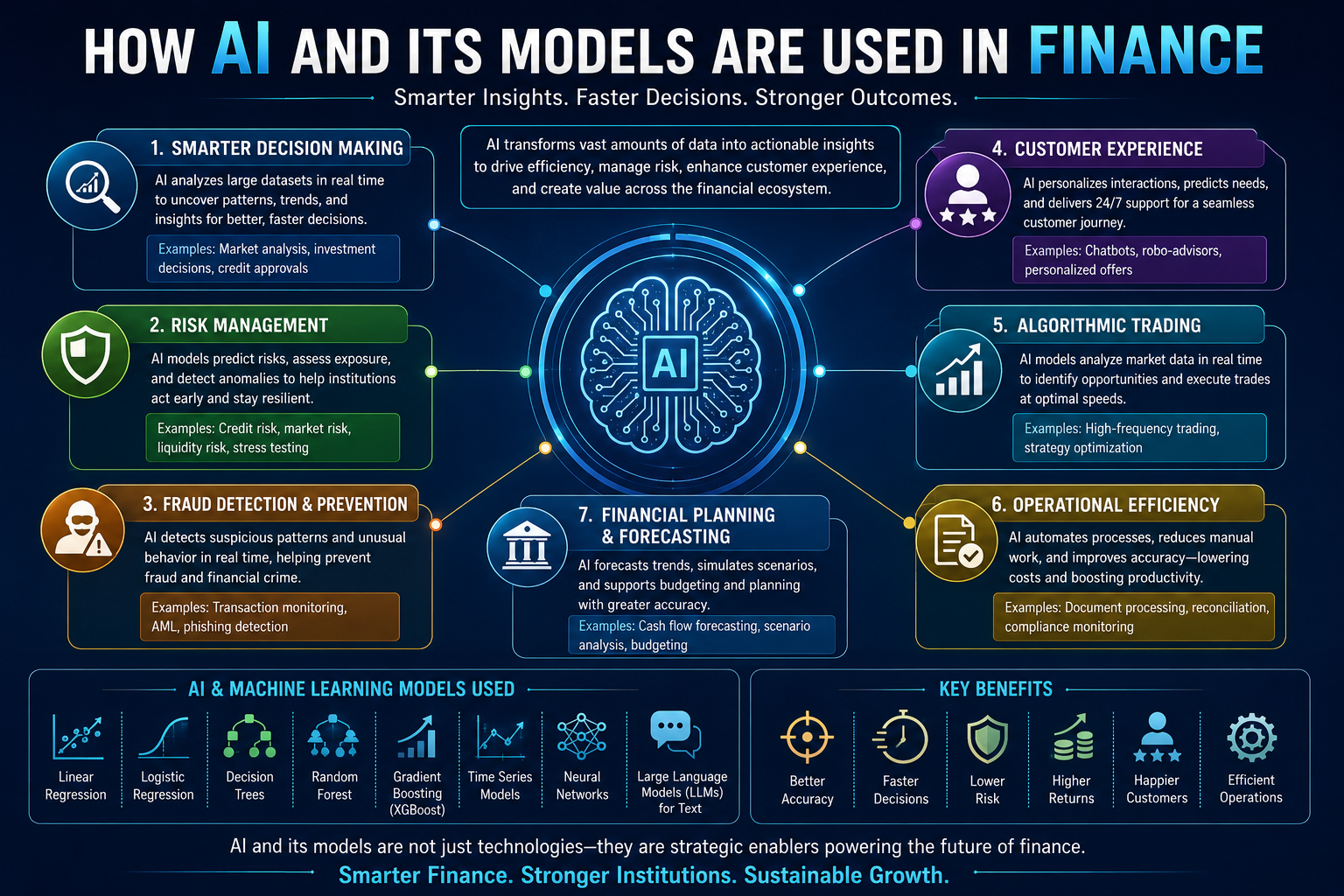
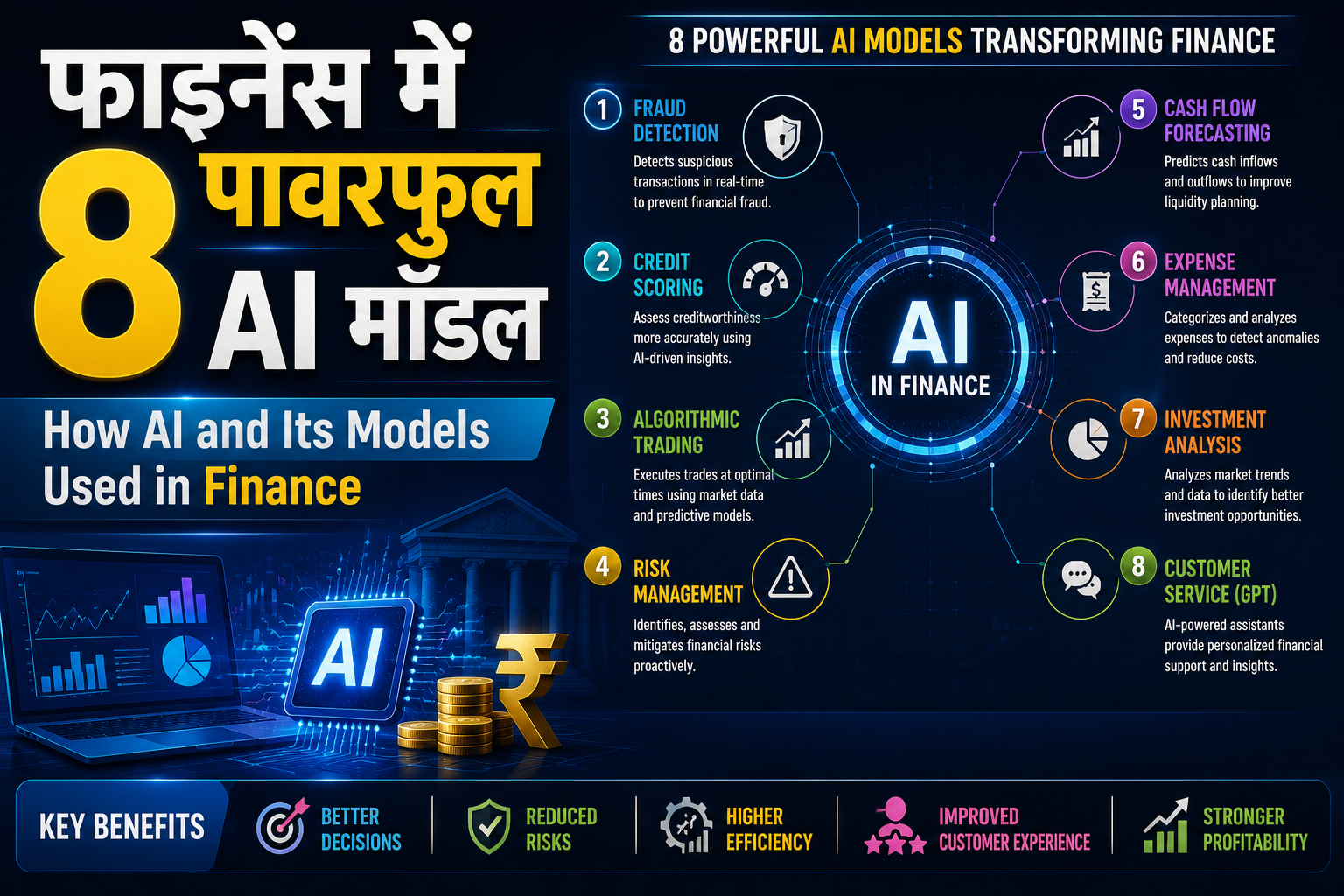
AI models in finance helping board members make strategic decisions through data analytics, fraud detection, credit risk assessment, and governance.
Why Every Board Member Must Understand AI Models Before Making Strategic Decisions
Artificial Intelligence is no longer a subject reserved for technology professionals. It is rapidly becoming a decisive force in finance, banking, insurance, governance, risk management, compliance, and strategic decision-making. As organizations increasingly rely on AI to approve loans, detect fraud, forecast business performance, assess risks, strengthen cybersecurity, and automate critical processes, board members can no longer afford to remain passive observers.
For me, understanding AI is not about becoming a data scientist or writing algorithms. It is about fulfilling a fundamental responsibility as a board member: making informed decisions, asking the right questions, challenging assumptions, and ensuring that technology serves the long-term interests of the company and its stakeholders.
I want to understand how AI models are built, why different models are chosen for different business problems, where they create value, and where they introduce risk. More importantly, I want to understand how boards should govern these models—ensuring they are ethical, transparent, explainable, secure, and aligned with the organization’s strategy.
Every AI-driven decision has the potential to influence financial performance, customer trust, regulatory compliance, and corporate reputation. Therefore, directors must possess sufficient AI literacy to oversee management effectively, evaluate technology investments, understand model risks, and ensure responsible AI practices are embedded across the enterprise.
The boardroom of the future will not be defined only by financial expertise or governance experience. It will also require technological awareness, ethical judgment, and the ability to integrate AI-driven insights into strategic oversight. Continuous learning in this area is no longer optional—it is an essential part of responsible board leadership.
This article explores the most widely used AI models in finance, their practical applications, their strengths and limitations, and the governance questions every board member should ask before relying on AI-enabled decisions.
A board member is not expected to write AI algorithms. Instead, they should understand:
- what AI models are,
- where they are used,
- what risks they introduce,
- how to govern them,
- and how to ask the right questions.
How AI Models Used in Finance
An AI model is a mathematical model trained on historical data to identify patterns and make predictions or recommendations.
For example:
Input Data
| Customer | Income | Age | Loan Amount | Previous Defaults |
|---|---|---|---|---|
| A | ₹12Lakh | 35 | ₹15 Lakh | No |
| B | ₹5 Lakh | 28 | ₹8 Lakh | Yes |
| C | ₹18Lakh | 45 | ₹25 Lakh | No |
The AI model learns from thousands or millions of such records.
Output:
- Approve Loan
- Reject Loan
- Require Manual Review
Major AI Models in Finance
1. Credit Risk Model
Purpose
Predicts whether a borrower will repay a loan.
Input
- Income
- Employment
- CIBIL Score
- Existing Loans
- Repayment History
- Bank Transactions
Output
Probability of Default
Example
Customer A, Income ₹15 lakh, Good repayment history, Stable employment
AI predicts:
Probability of default = 1.5%
Decision: Loan Approved
2. Fraud Detection Model
Used by Banks, Credit Cards, UPI, Insurance, Payment Companies
AI monitors Millions of transactions every second.
Example
A customer normally spends
₹5,000/day
Suddenly
₹4 lakh from another country.
AI immediately flags it.
Output
High Fraud Risk
Card blocked automatically.
3. Anti-Money Laundering (AML)
Banks must detect suspicious transactions.
AI identifies
- Layering
- Structuring
- Round Tripping
- Terror Financing Patterns
Example
One account receives
₹49,000 ten times in one day.
Instead of ₹4.9 lakh
This may indicate structuring to avoid reporting thresholds.
AI alerts compliance.
4. Customer Churn Prediction
AI predicts
Which customers are likely to leave.
Example
A customer
- visits the app less often
- complains frequently
- reduces transactions
AI predicts
85% probability of churn.
Relationship managers can intervene proactively.
5. Investment Recommendation Model
Used by
Mutual Funds
Wealth Management Firms
Brokerages
Inputs
- Risk profile
- Age
- Income
- Investment goals
- Market conditions
Output
Suggested investment portfolio.
6. Insurance Claim Prediction
AI estimates
Whether a claim is likely genuine or fraudulent.
Example
Claim amount
₹10 lakh
Hospital records
Location
Medical history
Past claims
AI calculates a fraud risk score.
7. Forecasting Models
Used for
Revenue Forecast, Sales Forecast, Cash Flow. Demand Planning
Example
AI predicts
Quarterly sales ₹320 crore instead of ₹285 crore
allowing management to adjust production and inventory.
8. Cybersecurity AI
Monitors
- Login attempts
- Malware
- Network traffic
- Data leakage
- Insider threats
AI detects attacks before humans notice them.
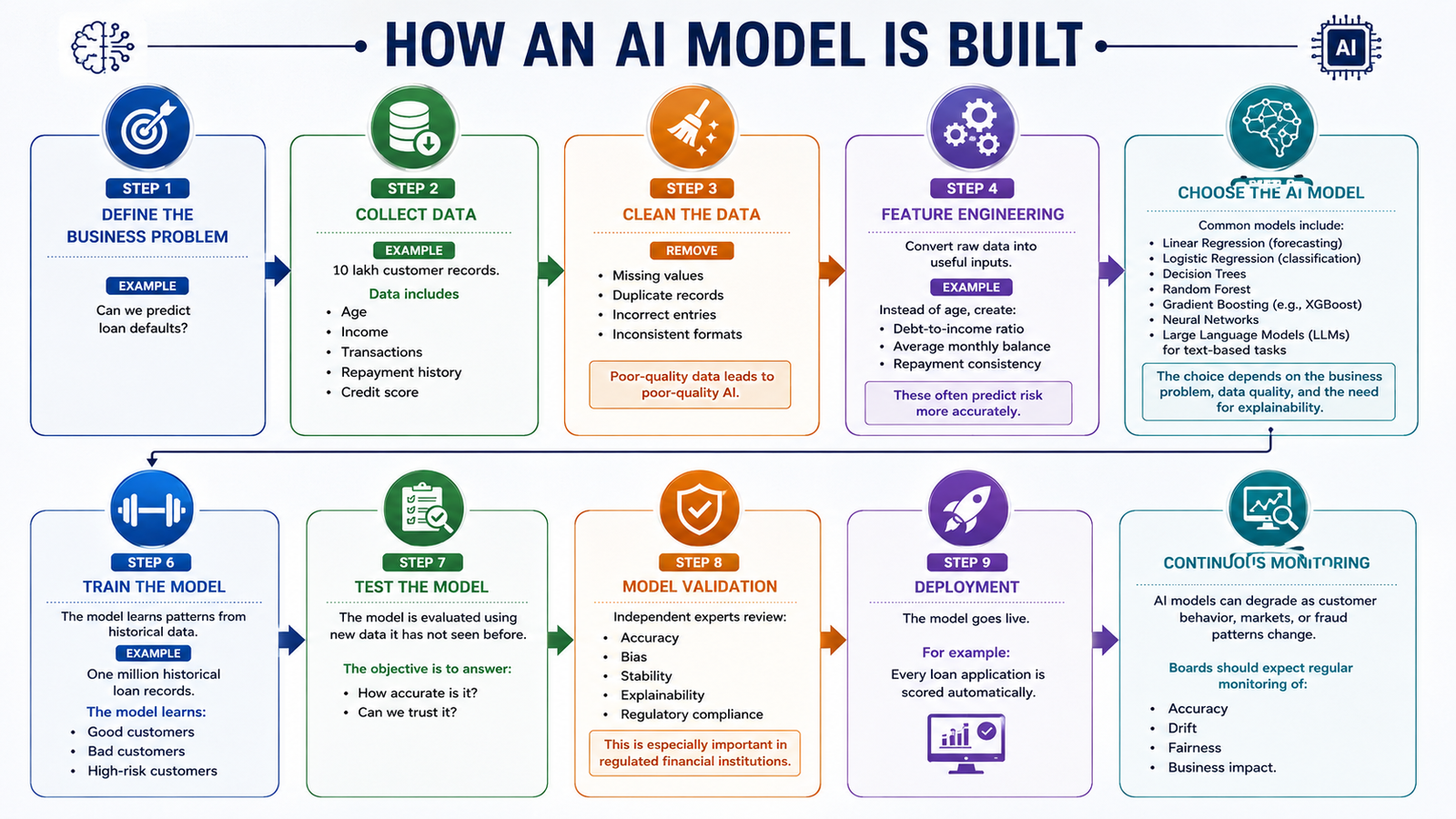
How an AI Model Is Built
AI Models Every Board Should Understand
| AI Model | Business Use | Board Concern |
|---|---|---|
| Credit Risk | Loan approval | Fairness, accuracy, default risk |
| Fraud Detection | Fraud prevention | False positives, customer impact |
| AML | Regulatory compliance | Compliance and financial crime |
| Forecasting | Business planning | Reliability of predictions |
| Churn Prediction | Customer retention | Ethical use of customer data |
| Investment Models | Portfolio management | Suitability and fiduciary duty |
| Cybersecurity AI | Threat detection | Operational resilience |
| Generative AI | Productivity and customer support | Hallucinations, privacy, governance |
Questions an Independent Director Should Ask
When AI is presented in the boardroom, consider asking:
- What business problem does this AI model solve?
- What data was used to train it?
- How accurate is the model today?
- How often is it independently validated?
- Can we explain its decisions to customers and regulators?
- How do we detect model drift?
- What controls exist if the model fails?
- Does it comply with applicable laws and regulations?
- Who is accountable for the model throughout its lifecycle?
- How does this AI model create value for shareholders while protecting customers and other stakeholders?