
Content insight
Toggle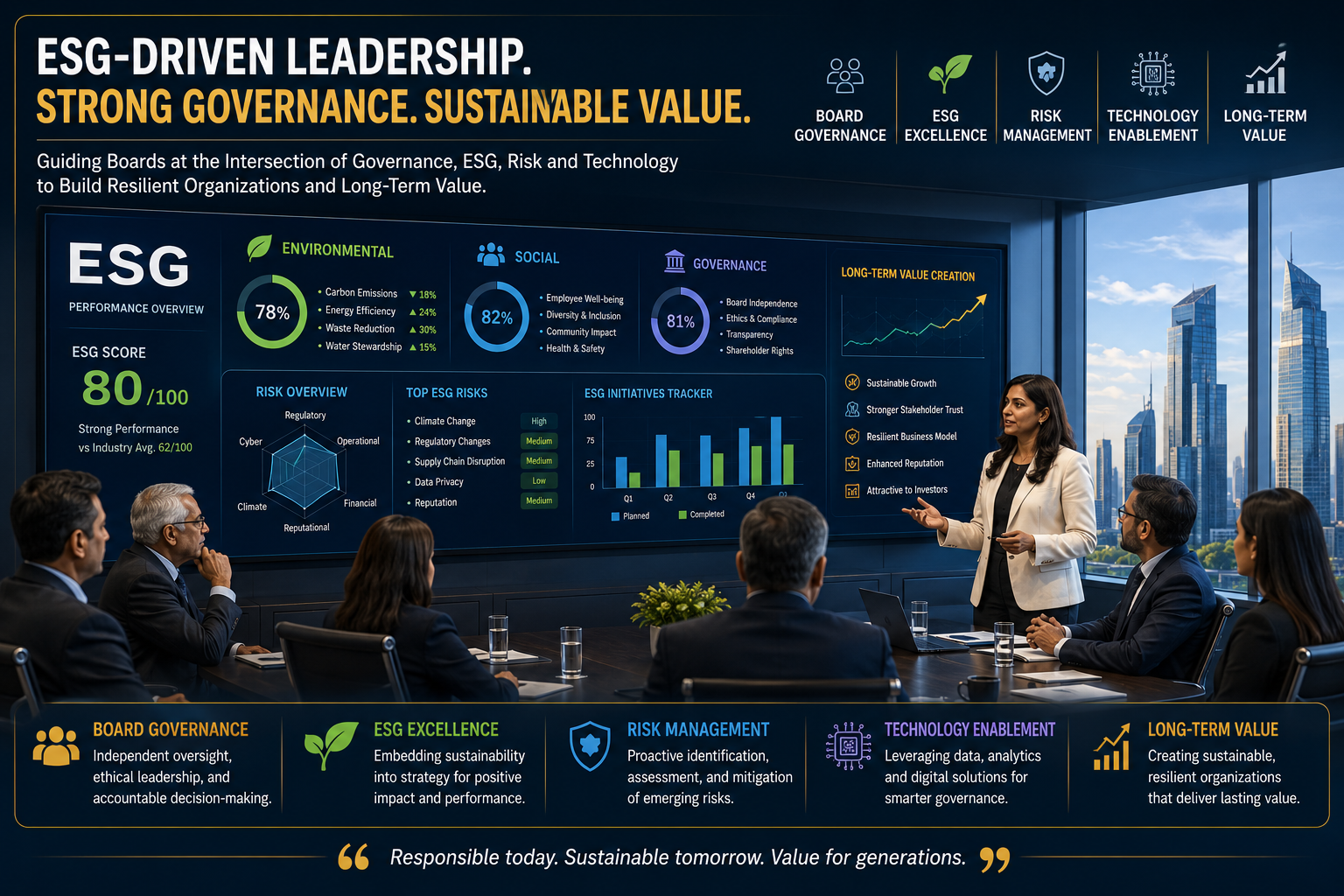
ESG for Independent Directors is no longer simply a matter of reviewing sustainability reports or checking whether a company has fulfilled its compliance obligations. It is increasingly becoming an important part of board-level strategy, risk management, ethical leadership and long-term value creation.
Environmental, Social and Governance (ESG) is about how responsibly and sustainably a company creates value.
The most important question is:
“Are we building a company that can remain profitable, trusted, resilient and responsible for the long term?”
Environmental, Social and Governance factors can influence a company’s reputation, financial performance, operational resilience, stakeholder trust and ability to respond to future challenges. For an Independent Director, understanding ESG means looking beyond today’s financial results and asking whether the organization is building a business that can remain profitable, responsible, resilient and trusted over the long term.
That is where ESG becomes a board-level responsibility.
What Is ESG?
ESG represents three interconnected dimensions of business performance:
E — Environmental
How the company affects and depends on the natural environment.
S — Social
How the company treats employees, customers, suppliers, communities and other stakeholders.
G — Governance
How the company is directed, controlled, monitored and held accountable.
These three areas are interconnected.
A company may have excellent environmental policies, but if its governance is weak, those policies may never be implemented effectively.
Similarly, a company may have strong profits, but poor employee practices or unethical conduct can eventually create financial and reputational risks.
Therefore:
ESG is not separate from business strategy. ESG is increasingly becoming part of business strategy.
2. Environmental: Protecting the Business and the Planet
The environmental component is not limited to climate change.
It can include:
- Energy consumption
- Carbon emissions
- Water management
- Waste management
- Pollution
- Biodiversity
- Natural-resource dependency
- Renewable energy
- Climate-related business risks
- Sustainable supply chains
Example
Consider a manufacturing company that depends heavily on water.
If water availability declines because of environmental conditions, the company may face:
- Production disruption
- Higher operating costs
- Regulatory restrictions
- Supply-chain problems
- Lower profitability
This is therefore not merely an environmental issue.
It is a business risk.
An Independent Director should ask:
“What environmental factors could disrupt our business model?”
“Are we preparing for those risks today, or will we respond only after they become a crisis?”
3. Social: People Are Also a Business Asset
The “S” in ESG focuses on how an organization interacts with people.
This includes:
- Employee welfare
- Health and safety
- Human rights
- Diversity and inclusion
- Employee development
- Workplace culture
- Customer protection
- Data privacy
- Product responsibility
- Supply-chain labor practices
- Community impact
Consider a company with excellent financial results but unusually high employee turnover.
That should make the board curious.
Why are experienced employees leaving?
Is there:
- Leadership fatigue?
- Poor culture?
- Weak career development?
- Excessive pressure?
- Lack of trust?
- Poor management practices?
These issues may not immediately appear in the profit and loss statement.
But eventually they can affect:
Productivity → Customer experience → Revenue → Profitability → Reputation
This is why an effective board looks beyond financial numbers.
4. Governance: The Foundation of ESG
For an Independent Director, governance is particularly important.
Governance determines how decisions are made, monitored and challenged.
Good governance includes:
- Board independence
- Ethical leadership
- Accountability
- Internal controls
- Risk management
- Audit oversight
- Related-party transaction oversight
- Whistleblower mechanisms
- Succession planning
- Executive compensation
- Transparency
- Regulatory compliance
- Cybersecurity oversight
- AI governance
A company may publish an impressive ESG report.
But the board should ask:
“Are the principles in this report actually reflected in the way the company is managed?”
That is the real test.
5. ESG Is Not the Same as CSR
This distinction is important.
CSR generally focuses on the company’s social responsibility initiatives and community contributions.
For example:
- Building schools
- Supporting healthcare
- Community development
- Skill development
- Environmental projects
ESG is broader.
It examines how environmental, social and governance factors are embedded into the core business and decision-making process.
For example:
A company donating money to environmental projects may be doing good CSR.
But if its own manufacturing operations are causing serious environmental damage, the board has a much larger ESG problem.
Therefore:
CSR can be part of ESG, but ESG is much broader than CSR.
6. ESG and Risk Management
One of the most important connections is between ESG and enterprise risk management.
Traditional risk management might focus on:
- Credit risk
- Market risk
- Operational risk
- Liquidity risk
- Financial risk
ESG expands the board’s perspective.
The board should also consider:
- Climate risk
- Human-capital risk
- Reputation risk
- Governance failure
- Supply-chain risk
- Cybersecurity risk
- Data-privacy risk
- Regulatory risk
- Technology risk
A strong board asks:
“Which ESG issue could become a significant financial or strategic risk if we ignore it today?”
7. ESG and Corporate Valuation
ESG can influence business value in several ways.
A company with strong governance and responsible practices may potentially benefit from:
- Greater stakeholder trust
- Better risk management
- Stronger customer loyalty
- Improved employee retention
- Better operational efficiency
- Stronger reputation
- Greater resilience
On the other hand, ESG failures can create:
- Regulatory penalties
- Litigation
- Customer loss
- Employee departures
- Higher costs
- Reputation damage
- Business disruption
Therefore, ESG should not be viewed merely as an expense.
It can be viewed as an investment in business resilience and long-term value creation.
8. What Should an Independent Director Do?
An Independent Director should not become the ESG manager of the company.
The role is different.
The Independent Director should provide:
Independent judgment
Challenge management assumptions when necessary.
Oversight
Ensure material ESG risks receive appropriate board attention.
Strategic perspective
Connect ESG issues with long-term business strategy.
Ethical judgment
Ensure that profitability does not become an excuse for irresponsible conduct.
Risk awareness
Identify issues before they become crises.
Accountability
Ensure that management has clear responsibility for ESG objectives.
9. ESG Questions Every Independent Director Should Ask
Instead of simply asking management:
“Are we ESG compliant?”
Ask:
Environmental
What are our three most material environmental risks?
What would happen to our business if those risks materialized?
Social
What are our employees and customers telling us that the financial reports don’t show?
Why are employees leaving?
Governance
If something serious goes wrong, will this board know early enough?
Are employees genuinely comfortable reporting misconduct?
Strategy
How could ESG affect our competitiveness over the next five years?
Risk
Which ESG risk could become a financial risk?
Accountability
Who is responsible for each ESG objective?
Measurement
How are we measuring ESG performance rather than merely describing it?
10. ESG and AI: A New Board Challenge
AI is creating another important dimension of ESG.
Companies increasingly use AI for:
- Credit assessment
- Recruitment
- Fraud detection
- Customer service
- Risk management
- Marketing
- Investment decisions
But AI creates questions around:
- Bias
- Privacy
- Transparency
- Accountability
- Cybersecurity
- Data quality
An Independent Director with AI awareness can help the board ask:
“Are we using AI responsibly, and can we explain its impact on our stakeholders?”
This is where technology governance and ESG governance increasingly intersect.
11. ESG and Company Culture
One of the most overlooked areas of ESG is organizational culture.
A company may have:
- Excellent policies
- Strong compliance manuals
- An impressive code of conduct
But what happens when employees face pressure to meet unrealistic targets?
That is when culture becomes visible.
A healthy culture encourages employees to:
- Speak up
- Report concerns
- Challenge unethical decisions
- Admit mistakes
- Protect customers
- Follow controls
A weak culture does the opposite.
And weak culture can eventually become a governance failure.
12. ESG and the Boardroom
A mature board should not discuss ESG only once a year.
ESG should become part of relevant board discussions involving:
- Strategy
- Risk
- Finance
- Investments
- M&A
- Human resources
- Technology
- Cybersecurity
- Supply chain
- Compliance
For example, before approving a major acquisition, the board could ask:
What ESG liabilities are we acquiring along with this business?
That question could uncover risks that traditional financial due diligence might overlook.
13. ESG Measurement
ESG should be measurable. and have Checklist
Boards can monitor indicators such as:
Environmental
- Energy consumption
- Emissions
- Water usage
- Waste
- Renewable energy usage
Social
- Employee turnover
- Safety incidents
- Training hours
- Customer complaints
- Employee engagement
Governance
- Audit findings
- Whistleblower complaints
- Related-party transactions
- Compliance breaches
- Board attendance
- Cyber incidents
The objective is not to create hundreds of metrics.
It is to identify the material indicators that genuinely affect the business.
14. ESG and the Three Questions of a Board
A practical way to approach ESG is to ask three questions.
Question 1: What can hurt us?
Identify ESG risks.
Question 2: What can strengthen us?
Identify opportunities for efficiency, innovation and competitive advantage.
Question 3: What must we change?
Create accountability and measurable action.
This converts ESG from a reporting exercise into a management discipline.
15. The Role of Ethics in ESG
ESG ultimately comes back to leadership.
A company can have sophisticated systems, but systems alone cannot guarantee ethical behavior.
Leaders must be willing to make difficult decisions when:
Profit conflicts with responsibility.
This is where ethical judgment becomes critical.
The teachings of the Bhagavad Gita, particularly the emphasis on disciplined action, responsibility and detachment from personal gain, can provide a valuable philosophical perspective for leadership.
In modern board governance, this can translate into a simple principle:
Do what is right for the long-term interest of the organization and its stakeholders, even when the easier decision may provide a short-term benefit.
16. ESG Is About Sustainability of the Company
Sustainability should not mean simply:
“Can the company survive environmentally?”
It should mean:
Can the company continue creating economic value while maintaining trust, protecting stakeholders, managing risks and operating responsibly?
That requires balance between:
Planet + People + Profit + Principles
And governance provides the mechanism for maintaining that balance.
17. The Independent Director's ESG Checklist
Before concluding an ESG discussion, an Independent Director should be able to answer:
- What are our most material ESG risks?
- Who owns each risk?
- Are ESG risks included in enterprise risk management?
- Are ESG objectives connected to strategy?
- Are targets measurable?
- Is ESG data reliable?
- Are disclosures accurate?
- Are employees encouraged to speak up?
- Are customers being treated fairly?
- Are suppliers being monitored?
- Are environmental risks financially assessed?
- Are governance weaknesses being addressed?
- Are AI and cybersecurity risks included?
- Does the board receive meaningful ESG information?
- Are management incentives aligned with sustainable performance?
Conclusion: ESG Is Not a Report. It Is a Reflection of Leadership.
The real ESG question is not:
“How good is our ESG report?”
It is:
“How good is the company when nobody is reading the report?”
That is where genuine ESG performance begins.
A sustainable organization is one where profitability is supported by responsible conduct, strong governance, resilient operations, ethical leadership and stakeholder trust.
For an Independent Director, ESG therefore represents much more than compliance.
It is an opportunity to ask the difficult questions early, identify risks before they become crises, challenge short-term thinking, and help the company build lasting value.
Good governance protects today’s business.
Responsible ESG leadership protects tomorrow’s business.