
Content insight
Toggle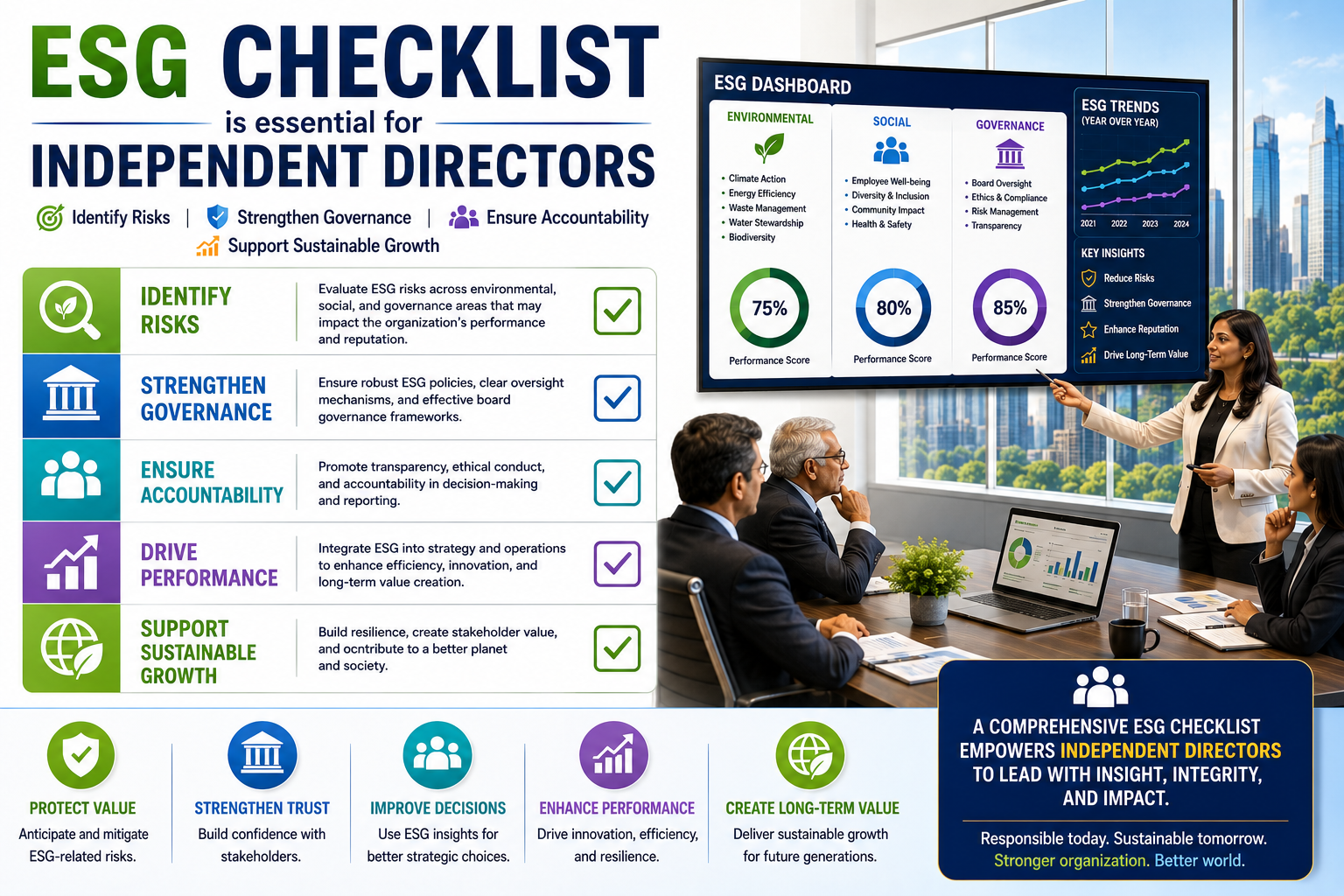
For an Independent Director, ESG should not be treated as a reporting exercise. It should be viewed as a board-level system for protecting long-term value, reputation, resilience, stakeholder trust, and regulatory readiness.
Follwing would be the ESG checklist For Independent Director
1. Environmental — “Are we protecting the business from environmental risks?”
- Does the company identify its major environmental risks?
- Are energy consumption and emissions being measured?
- Is the company setting realistic environmental targets?
- Are climate-related risks incorporated into enterprise risk management?
- Is water consumption and availability monitored where relevant?
- Is waste management properly controlled?
- Are environmental laws and permits being complied with?
- Are suppliers being assessed for environmental risks?
- Is the company prepared for climate-related business disruption?
- Are environmental claims independently supported rather than merely promotional?
Board question:
“What environmental risk could materially affect our business in the next five to ten years?”
2. Social — “How are we treating people and managing human-related risks?”
- Is employee safety properly monitored?
- Is employee turnover increasing?
- Is there a mechanism for employees to raise concerns safely?
- Are diversity and equal-opportunity practices monitored?
- Are human-rights risks considered in the supply chain?
- Are customer complaints analyzed for recurring problems?
- Is customer data being responsibly protected?
- Are products and services being provided fairly?
- Is the company monitoring employee well-being and workplace culture?
- Is there a succession and leadership-development plan?
Board question:
“What are employees, customers, suppliers, and other stakeholders experiencing that may not appear in our financial statements?”
3. Governance — “Are we being governed with integrity and accountability?”
This is particularly important for an Independent Director.
- Is the board genuinely independent in its thinking?
- Are difficult issues openly discussed?
- Are conflicts of interest properly disclosed and managed?
- Are related-party transactions appropriately reviewed?
- Is the whistleblower mechanism effective and trusted?
- Are internal controls working in practice?
- Are audit findings closed on time?
- Are financial irregularities investigated promptly?
- Is executive compensation aligned with long-term performance?
- Is succession planning adequate?
- Are board committees functioning effectively?
- Is cybersecurity receiving appropriate board attention?
- Is AI being used responsibly and governed appropriately?
- Is management held accountable for commitments made to the board?
Board question:
“If something important is going wrong inside the company, will the board know early enough to act?”
4.ESG Governance Checklist for the Board
An Independent Director should also examine whether ESG is actually integrated into decision-making.
- Is there a clear ESG policy?
- Who is accountable for ESG at management level?
- Does the board receive regular ESG reporting?
- Are ESG risks included in the enterprise risk register?
- Are ESG objectives linked to business strategy?
- Are measurable KPIs established?
- Are ESG targets realistic and evidence-based?
- Are ESG disclosures accurate and consistent?
- Is ESG data independently verified where appropriate?
- Are material ESG risks escalated to the appropriate board committee?
- Does the company have an ESG crisis-response plan?
- Are ESG issues considered during major investments, acquisitions, and strategic decisions?
Why ESG Is Very Important for an Independent Director
1. ESG Can Become a Financial Risk
Environmental damage, employee issues, fraud, poor governance, cybersecurity incidents, or regulatory failures can eventually become financial problems.
The Independent Director therefore needs to look beyond the balance sheet.
2. ESG Protects Long-Term Value
A company may report excellent profits today but still be accumulating serious risks.
For example:
High profits + poor governance + unhappy employees + weak controls = potentially fragile business.
The board’s responsibility is to identify that fragility before it becomes a crisis.
3. ESG Strengthens Risk Management
ESG expands the board’s risk perspective.
Traditional risk question:
“What financial risks do we have?”
ESG adds:
“What environmental, social, ethical, technological, and governance risks could affect our financial performance in the future?”
4. ESG Influences Stakeholder Trust
Customers, employees, investors, lenders, regulators, and business partners increasingly evaluate how responsibly an organization operates.
Trust takes years to build but can disappear quickly.
5. ESG Is Closely Connected With Governance
For an Independent Director, G—the Governance component—is especially important.
A board cannot claim strong ESG performance if:
- accountability is weak,
- controls are ineffective,
- management hides problems,
- conflicts are unmanaged,
- whistleblowers are ignored,
- or decisions are not properly documented.
Good governance is the foundation on which credible ESG performance is built.
The Most Important ESG Questions for an Independent Director
Rather than asking management only “Are we ESG compliant?”, ask more challenging questions:
- What are our three most material ESG risks?
- Who is accountable for each risk?
- How are we measuring progress?
- What could happen if we fail to address these risks?
- How could ESG affect revenue, cost, reputation, valuation, or access to capital?
- Are we reporting what is actually happening—or what we want stakeholders to believe is happening?
The Independent Director's Real Contribution
The value of an Independent Director in ESG is not simply approving ESG reports.
It is bringing independent judgment, ethical clarity, risk awareness, technology understanding, and long-term perspective to ESG decisions.
A mature board should therefore move from:
ESG as reporting → ESG as risk management → ESG as strategy → ESG as long-term value creation.
That is where ESG becomes meaningful for the company, its shareholders, employees, customers, and wider stakeholders.